Mote · iPhone
Your friend walked this. Mote drew it.
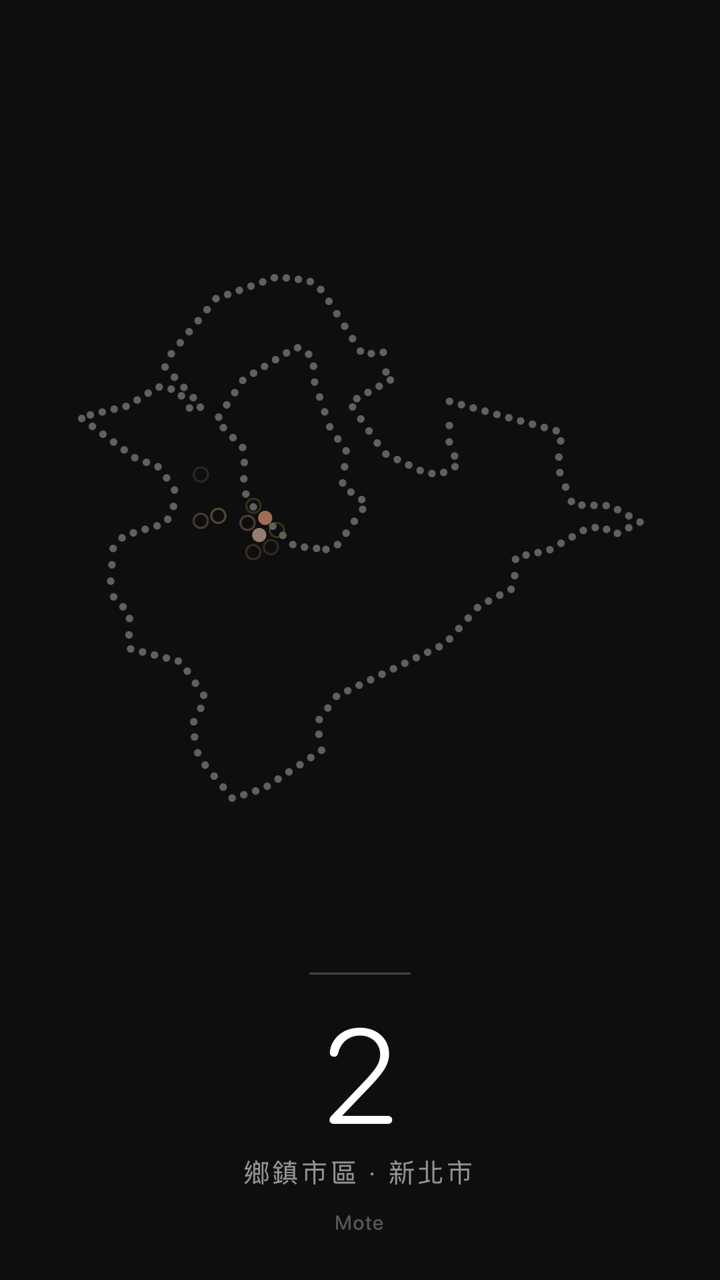
Every dot is twenty-five metres of ground. Solid where they spent time, hollow where they only passed through. Nobody drew it by hand and nobody checked in anywhere — the map filled itself in while the phone was in a pocket.
Mote isn't out yet.
It is not on the App Store. When it is, there will be a link right here — and until then I would rather show you an honest sentence than a button that does nothing. If you want to know the day it ships, send me an empty email and I will tell you and nothing else.
One email, once, when it ships. No list, no newsletter, nothing else sent to you ever. Made by CharlX Studio, one person in Taiwan.
What you are actually looking at.
Mote draws the ground you have stood on — one hexagon at a time, about twenty-five metres a side. It works in your pocket, with nothing to start and nothing to check in to. The colours are not the app's: every one of them is lifted from a photograph you took there, which is why no two of these cards look alike.
The number is the only claim on the card, and it is a count of places with names — not a percentage of anything.
What happens if you install it.
- Open it once. The map is blank, which is the point. Mote asks for your location and the first dots appear where you are standing.
- Let it dig up your photographs. There are already years of this in your library — Mote reads only when and where each one was taken, never the picture, and fills in the map you already made.
- Then forget about it. It fills in while your phone is in your pocket, and names the districts as you finish them.
Progress with a denominator you can name.
Every other map like this tells you what fraction of the Earth's surface you have covered, which is a number with no human meaning. Mote counts against places that have names: nine of the twelve districts in Taipei. You know what that means, and you know which three are missing.
And there are no trips. Mote never asks you to start one or end one, because a Tuesday is as real as Kyoto — the map of a life is mostly made of the same ten streets, and that is not a failure of the map.
Your map is a file on your phone.
Not a promise I am making — a fact about how it is built. Your location becomes hexagons and is written into the app's own storage. There is no account. There is no sign-in, no email address, no analytics and no crash reporter. The boundary data that names your districts is inside the app, so the whole thing works with the radio off.
The App Store label is Data Not Collected, and it is that because of the architecture rather than because of a policy. The privacy page lists everything that can leave, and what has to happen first →
What it doesn't do.
No account, ever
No email, no password, no phone number, no contacts and no advertising identifier. There is nothing to sign into and nothing to sign out of.
No pace, no calories, no distance
Mote records places, not routes, so it genuinely cannot tell you how far you walked. That is the same property that lets a shared map be a shape instead of a story.
No streak to lose
Nothing here expires and nothing is taken away for not walking. Miss a month and your map is exactly where you left it.
No trap on your data
Everything Mote knows about where you have been exports as JSON and GeoJSON, all of it, free, from day one. GeoJSON opens in map software that is not Mote.
One map, shared between a few people.
If you want to, and if you have someone to do it with, you can put one map between up to eight people who hold the same invite code. Everyone sees where everyone has walked — and nothing about when, in what order, or how fast.
The code is the encryption key, and it never reaches the server. Your cells are sealed on your phone before they are sent, so what is stored is an identifier nobody can reverse and a block nobody can read. Your home and your work are dropped on the device before any of that happens, so they are absent from what is published rather than hidden by a query. And if you never join one, none of this ever applies to you. How a canvas works, in full →
And it makes something out of the parts it could not walk.
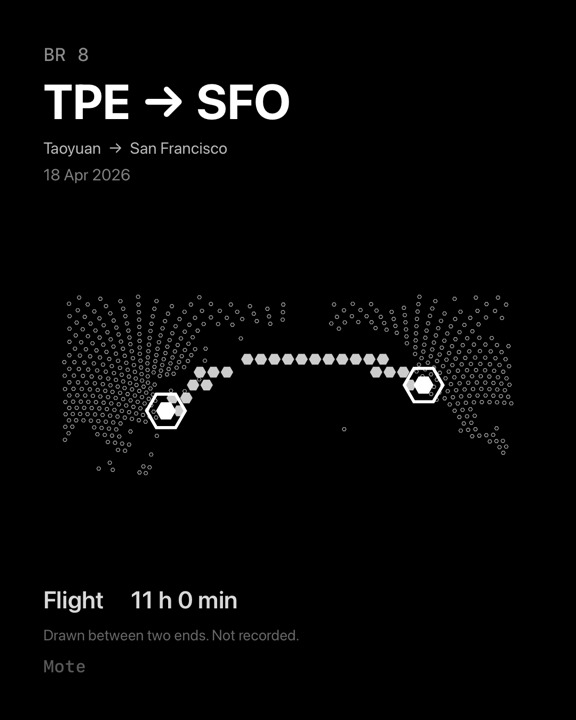
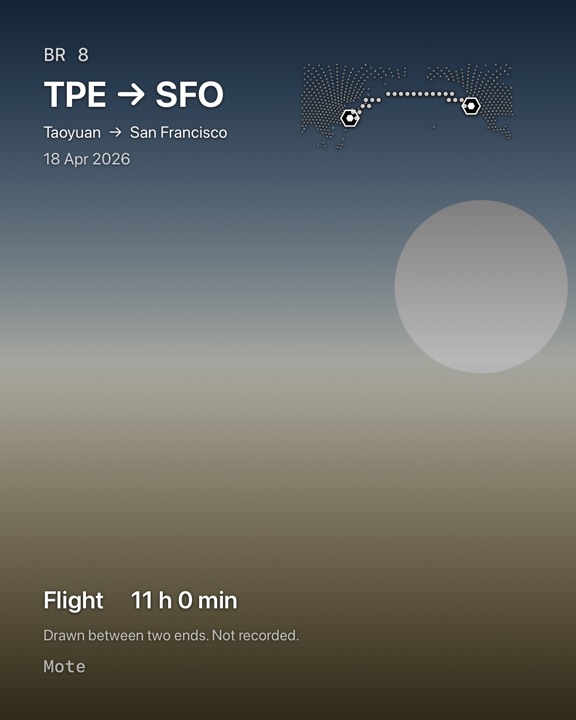
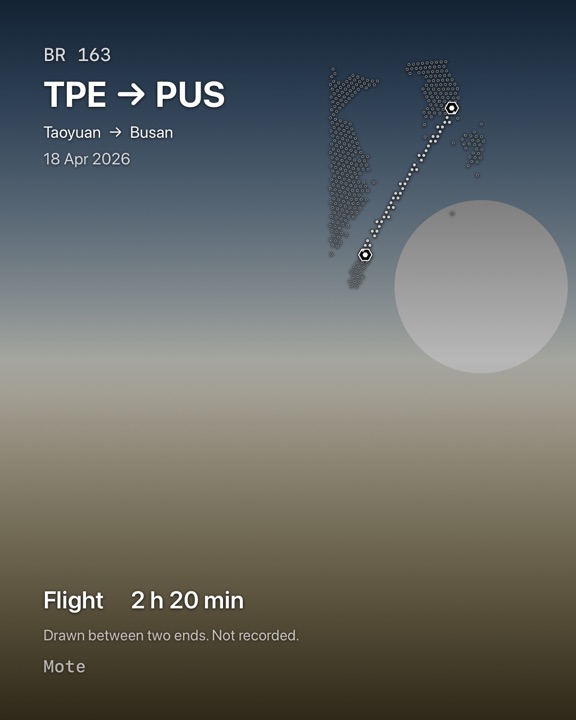
Mote knows a flight is not a walk. So it does not record one — it draws the arc between the two ends and says so on the card, in those words.